


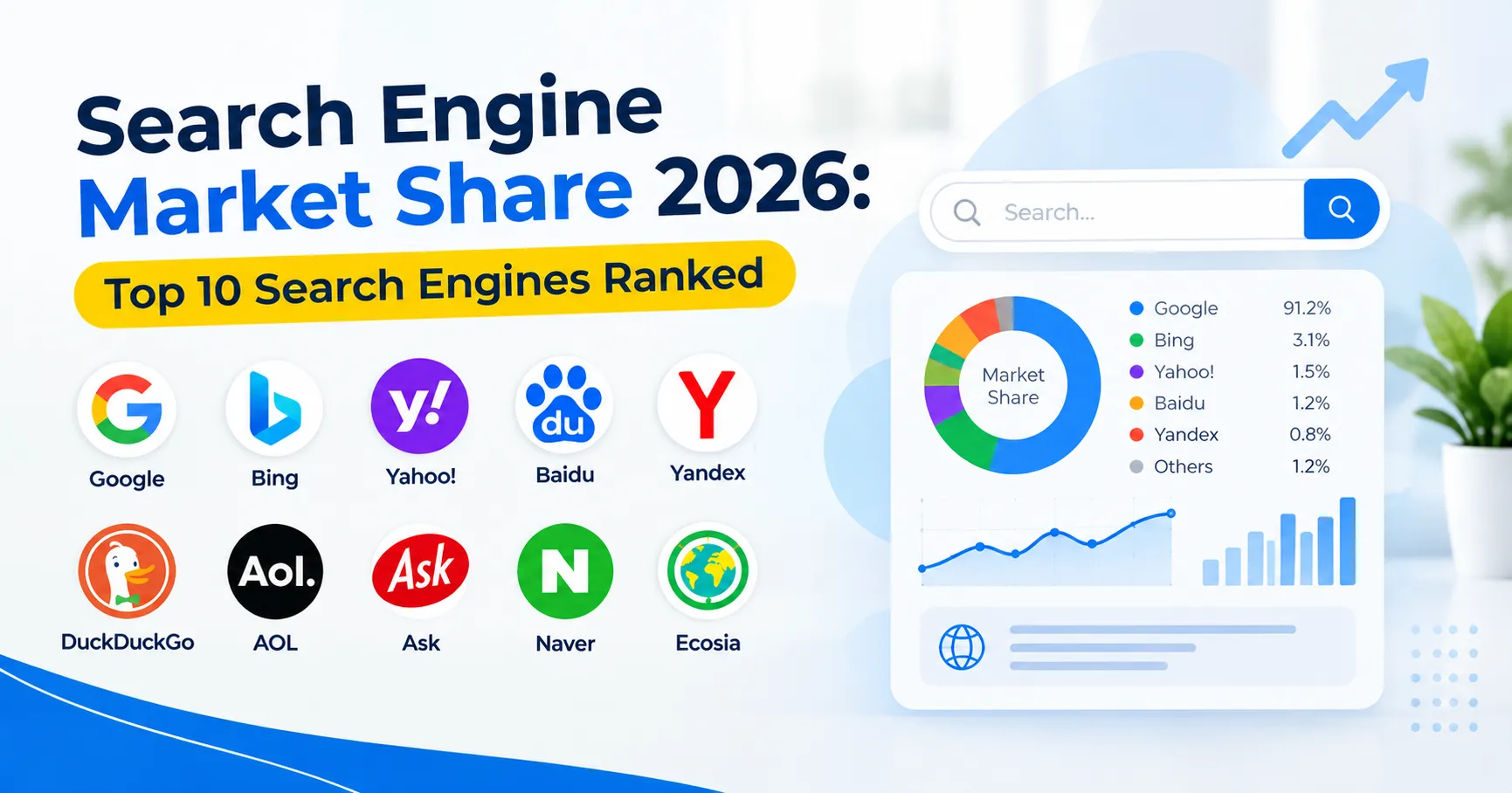
Quick question, when did you last actually stop and think about which search engine you were even using before you typed something in? Probably never. You just type, hit enter, and there’s your answer. Nobody questions it. But there’s real money and real strategy behind search engine market share, who’s winning that traffic war, and it’s a more interesting topic than most people give it credit for, especially if you run a website or care about getting found online. Here’s a look at the top 10 search engines by search engine market share (also known as search engine usage share) in 2026, with the actual story behind each name.
1. Google Search Engine Market Share: ~90%
Google’s search dominance hovers right around 90% these days. Say it plainer: type something into nine different browsers and eight or nine of them probably ran through Google without you even noticing. What’s more interesting than the number itself is how Google keeps its global search share that way year after year. It’s not really about having the smartest algorithm anymore, if that was ever the full story. Android ships with it built in. Chrome’s address bar is basically a Google search box wearing a disguise. Maps, YouTube, Gmail, all of it loops back eventually, and together these things keep Google’s search traffic slice locked in place. You don’t really “choose” Google, you just end up there because everything around you was built to lead you back. Every fresh look at Google market share, top search engines 2026, and search engine statistics 2026 tells the same story.
2. Bing Search Engine Market Share: ~5%
People underestimate Bing because “just 5%” of search share sounds small. But at the scale of global search, 5% of the search pie is still a massive audience, hundreds of millions of users. Beating Google was never really the plan here, that’s just not the game Bing is playing. It’s parked comfortably inside Windows and Edge, quietly picking up everyone who’s never bothered to change their default settings. And now, with Copilot woven into the mix, Bing’s search engine popularity has been climbing bit by bit, mostly on desktop. Track search engine usage statistics, search engine market share by country, or Google market share side by side and Bing still comes out a distant but steady number two.
3. Yahoo Search Engine Market Share: ~1.5%
Yahoo’s search standing survives almost entirely on nostalgia at this point. People who signed up back in 2004 are still logging in out of pure habit, and that loyal base is exactly what keeps Yahoo’s search numbers stable. The tech running behind its results isn’t even fully Yahoo’s own anymore. But habit’s stubborn like that. Doesn’t really move the needle on Yahoo’s browser search share one way or another. In most top 10 search engines rankings for 2026, Yahoo sits comfortably outside the top three, right alongside Bing market share as a familiar also-ran.
4. Yandex Search Engine Market Share: ~1.2%
On a world map, Yandex’s search footprint is basically invisible, less than 1%. Then you land in Russia and the whole picture flips. Google isn’t running the show there anymore, Yandex is, and it’s holding more than 70% of the local search slice (its regional search engine ranking) in that country alone. Worth remembering next time a global search stat looks too clean, because sometimes it’s hiding an entire market underneath it. This is exactly the kind of nuance a search engine market share by country breakdown captures that a flat search engine market share 2026 table never will, no matter how many global search engine market share figures you pile on top.
5. DuckDuckGo Search Engine Market Share: ~0.7%
DuckDuckGo’s search slice stays small, but it hasn’t stalled out either, it keeps creeping upward. The pitch has always been simple, no tracking, period, nothing more to it. It was never going to out-scale Google, and honestly that doesn’t seem to be the point anyway. More people care about privacy with each passing year, even if it’s just a little more, and that shift is basically what keeps feeding DuckDuckGo’s slow-but-steady search engine usage growth. Even the latest top search engines 2026 roundups and search engine statistics 2026 reports admit it’s the privacy story, not raw search engine usage statistics, that keeps DuckDuckGo relevant.
6. Baidu Search Engine Market Share: ~0.5% (Dominant in China)
Look at Baidu from outside China and it barely registers, just a small line in the global search numbers. Step inside the country though and it’s a completely different story, it’s the default, the name people trust, the platform every local business builds around first. Writing off Baidu because its global search presence looks small means missing an entire market, since Baidu’s local search footprint (and its dominant search engine ranking in China) sits above 45%. So the question worth asking isn’t why Baidu’s global number stays low, it’s why anyone would judge it by that number in the first place. Any honest search engine market share by country view, next to Google market share and Bing market share figures, makes that clear fast.
7. Naver Search Engine Market Share: Regional Leader (South Korea)
Naver’s global search presence looks tiny on paper, but spend five minutes using it inside South Korea and you’ll see it’s more of a portal than a plain search engine, search, news, shopping, community boards, all rolled into one. South Korea basically runs on it. Google is technically there too, but it plays a distant second in a country that already belongs to Naver and its search foothold, or what locals might just call its search platform dominance. It rarely cracks global top 10 search engines lists, yet its own search engine market share 2026 numbers inside Korea tell a very different story.
8. Ecosia Search Engine Market Share: Small, Values-Driven
Ecosia’s global search footprint is tiny, and honestly, it’s not even trying to win the numbers game. Every search funnels ad revenue into planting trees, that’s the whole hook, plain and simple. And because of that, Ecosia’s search numbers tend to grow organically, driven more by values than by speed or search quality. For people who switch based on what a company stands for, that reason alone is enough to nudge its search traffic share upward. It’s a reminder that global search engine market share figures don’t always chase the same search engine market share 2026 headlines as Google or Bing do.
9. Seznam Search Engine Market Share: Local Winner in Czech Republic
Seznam’s search presence stays alive in the Czech Republic because it understands the local language and culture better than Google does. There, Seznam’s local search foothold sits above 12%, ahead of even Bing. It’s basically the same story behind most local search engines that manage to hold onto their search performance and local search engine standing, they just know their own backyard better than any global giant ever could. In a search engine market share by country table, Seznam beats Bing market share and search engine statistics 2026 averages hands down inside its home market.
10. Ask.com Search Engine Market Share: Legacy Brand
Ask.com’s search relevance is now almost negligible. Remember that old “ask a question, get a direct answer” branding? That feels like a lifetime ago. It’s barely pulling any meaningful traffic these days, but the name still pops up on lists like this one out of habit. At this point, Ask.com’s search footprint is basically just brand memory, nothing more than that. Pull up any top 10 search engines list or search engine usage statistics table and Ask.com is the name everyone recognizes but nobody actually uses, a fair distance behind Google market share.
Why Google’s Search Engine Market Share Stays So High
The “smartest algorithm” explanation was never really the full story behind Google’s search dominance. A bunch of smaller things stack on top of each other instead. Android reaches nearly every corner of the mobile world. Chrome is already sitting open on most people’s screens. Default search deals get baked into devices before anyone even finishes setup, and all of these pieces together keep Google’s search engine footprint consistently high. Add years of indexing infrastructure that’s genuinely hard for anyone else to replicate. And then there’s just plain habit, two decades of people saying “just Google it” without giving it a second thought. Every search engine market share 2026 forecast and global search engine market share chart keeps landing on the same conclusion.
None of that makes everyone else’s search standing pointless, though. Bing, Yandex, Baidu, Naver, each one carries real weight depending on which audience you’re actually trying to reach, and which country-level search standing matters most to your business. Compare top search engines 2026 rankings against search engine statistics 2026 and search engine usage statistics, and the regional players still hold real ground.
How AI Search Is Quietly Reshaping Search Engine Market Share
Something’s shifting here that’s worth paying attention to when it comes to overall search numbers. More people are skipping the results page entirely and just asking AI tools directly, which is slowly chipping away at traditional search traffic and search engine adoption alike. Traffic into AI assistants keeps climbing steadily, but the traffic flowing back out to actual websites isn’t keeping up at the same pace. That gap feels a little uncomfortable once you actually sit with it. Even search engine market share by country data and Google market share trackers are starting to flag the shift.
Being “found” in terms of search standing isn’t only about ranking position anymore, that part of the game has changed. Write so an AI system could actually read the page and summarize it correctly, without twisting what you meant. That means putting the real answer near the top instead of making people scroll for it. It means headings that follow an actual train of thought, not ones picked because they sound catchy. It means backing claims with sources someone could actually check. And it means not letting numbers go stale, because outdated stats quietly cost more trust than most people assume, whether you’re citing search engine market share 2026, top search engines 2026, or plain search engine statistics 2026.
What Search Engine Market Share Means for Website Owners
Google is still priority number one for most sites given its search dominance, no real argument there, it controls the biggest slice of traffic by a wide margin. But putting everything into a single basket has never been a smart long-term move, and that’s more true now than it used to be. Watching search engine usage statistics, search engine market share by country, and Google market share together gives a much fuller picture than any single number.
Regional players like Baidu, Yandex, Naver, and Seznam can completely flip the numbers once you zoom into local search slice instead of looking at the global picture, depending on which country you’re actually targeting. DuckDuckGo’s crowd is smaller, sure, but it isn’t shrinking either. AI answer engines are already pulling content and summarizing it before a single click ever reaches the original source. Add the boring technical basics on top, crawlability, page speed, structured data, and that’s essentially what quietly decides most of the outcome underneath all of this, and ultimately your share of the search pie. Keep an eye on Bing market share and top 10 search engines trends while you’re at it.
Quick Checklist: Better Visibility for Search Engine Market Share
- Check that pages are actually crawlable. No stray noindex tags or blocked robots.txt rules hiding somewhere unexpected.
- Keep one clear H1 per page, and let everything else fall under H2s and H3s, folding in related terms like search query share and search engine market share 2026 where it reads naturally.
- Write for what people are genuinely searching for, not just to tick a keyword box.
- Don’t let the numbers go stale, outdated stats quietly cost more credibility than people expect, especially on a topic like search rankings, global search engine market share, or search engine statistics 2026.
- Build real trust signals, author details, sources, visible update dates.
- Link related pages together so both readers and crawlers understand how things connect.
- Structure content so AI systems can parse it too, direct answers and tables go a long way here, whether you’re referencing top 10 search engines or search engine market share by country.
FAQs: Search Engine Market Share
What is the most popular search engine in the world by search share? Google, and it’s not close. Something like 90% of the world’s search traffic flows through it, and every search engine market share 2026 and global search engine market share report says the same thing.
Which search engine holds the second-largest search presence? Bing, sitting around 5% of the worldwide search pie, mostly thanks to Windows and Edge. Look at top search engines 2026 or search engine statistics 2026, and Bing market share always lands in that same second spot.
Does Bing’s search standing still matter for SEO? More than most people give it credit for, honestly. Desktop users, Edge, Windows search, and its growing AI features all keep Bing’s web search share relevant, and it still shows up clearly in search engine usage statistics, search engine market share by country, and general Bing market share tracking.
Is DuckDuckGo’s search slice actually growing? Bit by bit, yes. It’s still a small piece of the global pie, but the privacy-conscious crowd keeps growing year after year, and that’s really what keeps feeding DuckDuckGo’s search numbers, a trend visible in top 10 search engines and search engine market share 2026 data alike.
Why does Baidu’s search footprint matter if the global number looks so small? Because that small number hides the real picture. Inside China, Baidu’s local search presence puts it almost on par with a local Google. The worldwide chart just doesn’t tell that side of the story, which is exactly why search engine market share by country, global search engine market share, and search engine statistics 2026 views matter more than one global figure.
Will AI search replace traditional search rankings? Not entirely, and probably not soon. AI tools are changing how people look things up, but traditional search share and overall online search share still carry most of the real traffic. Safer to just optimize for both, keeping an eye on search engine market share, Google market share, and top 10 search engines as the landscape shifts.





Leave a Reply